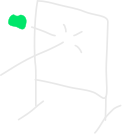


In this phase, we break the idea down into two fundamental components: the recipient’s situation and motivation, and the idea owner’s situation and unique advantages. The goal is to form a clear picture of the hypotheses that make up the idea and how important they are in relation to each other.
We explore what the customer is truly trying to achieve, how and when the idea helps them, and why it matters. By mapping both perspectives — the recipient’s needs and the creator’s unique strengths — we can uncover what truly drives the idea forward.
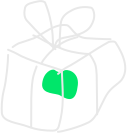
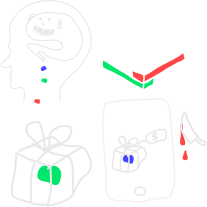
Idea packaging is about making the idea tangible — something that others can react to, feel, and form an opinion about. It’s not about proving that it works technically, but about discovering whether people would actually want it.
This is also called a pretotype: a simple first version that explores desire rather than function. By visualizing and narrating the idea, we create a lightweight facade that lets us learn from real reactions before investing further.
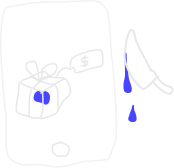
Testing is about designing thoughtful experiments, running them, and reflecting before the next one. The goal isn’t to confirm the idea, but to reveal the truth about its supposed value for the intended audience. In startup terms: is there a product–market fit?
Testing lies at the heart of idea validation. Through iteration, exploration, and repeated exposure to reality, the idea evolves — it learns, grows, and becomes something more resilient and meaningful.


At the risk of sounding cocky or pretentious, I’d still claim I’m a bit more curious than most guys. I often say I’m addicted to curiosity kicks — kicks from new thoughts or new feelings.
New thoughts can be smart solutions or fresh perspectives for understanding a problem or phenomenon. Emotional kicks come from aesthetic expressions — like a perfect logo or a catchy song. For me, ideas are the vessel for those kicks.
I’ve worked with ideas and development for most of my life and am familiar with most frameworks and processes within innovation. The ones that have stuck with me — and that I primarily use — are: Jobs-to-be-Done (Clayton Christensen, Bob Moesta), Customer Discovery/Lean Startup (Steve Blank, Eric Ries) och Pretendotyping (Alberto Savoia).
I believe in personal chemistry, and my view of what makes a good collaboration isn’t about experience or status — it’s about curiosity and resonance.